Why we go further than any certification — and what that means for your baby.
Who defines what a pollutant is?
For most certifications, it’s a list — what’s on it gets tested. What’s not on it doesn’t exist. This leads to a situation that the Federal Environment Agency and the Federal Institute for Risk Assessment have been critically monitoring for years: substances like PFAS were permitted for years in “tested for harmful substances” products, even though their hazardous nature was long known.
Our definition: Pollutants are substances that demonstrably harm or are suspected of harming babies and the environment. Not what a standard currently allows, but what current science says.
The BfR states: Approx. 50% of German adults and adolescents exceed the health-based guidance value for PFAS. The Federal Environment Agency documents PFAS transfer via breast milk. The US Environmental Protection Agency (EPA) classifies PFOA and PFOS as carcinogenic and immunosuppressive. These substances were permitted for years in “tested for harmful substances” baby products.
Sources: BfR — PFAS Statement (bfr.bund.de) | UBA — GerES-V Study (umweltbundesamt.de) | EPA — Final Risk Assessments PFOA/PFOS 2024 (epa.gov)
Why “tested for harmful substances” does not mean “free of harmful substances”
PFAS — Forever Chemicals
PFAS are over 10,000 synthetic chemicals that are practically not degraded in nature. They are used as water-repellent coatings in textiles — including stroller fabrics. What authorities and scientists say:
- EPA (2024): Final toxicity assessment — reduced fertility, decreased birth weight, immunosuppression, increased cancer risk (prostate, kidney, testicular).
- UBA: PFAS transfer via breast milk documented, accumulation in fatty tissue. GerES-V Study: 21% of samples above HBM-I value for PFOA.
- BfR: In infants of exposed mothers — reduced antibody concentrations in the first years of life. The immune system is weakened.
- WHO: Recommendation to discontinue non-essential PFAS applications.
- EU: Five countries (DE, DK, NL, SE, NO) are developing a comprehensive PFAS restriction under REACH — finalization 2026/2027.
Sources: EPA — epa.gov/pfas | UBA — umweltbundesamt.de | BfR — bfr.bund.de | WHO — who.int | ECHA — echa.europa.eu
Oeko-Tex Standard 100 — good, but is it enough?
Oeko-Tex Standard 100, Product Class 1 (baby articles), is the most frequently cited standard in the stroller industry. What many do not know:
Until the end of 2023, the intentional use of PFAS was permitted under Oeko-Tex. Only since January 2024 has a ban been in effect (limit value: 100 mg/kg total fluorine, tightened to 25 ppb from 2026). This means: For years, babies in “tested for harmful substances” strollers wore fabrics with PFAS treatment — and this was standard-compliant.
The question for parents: If a certification has permitted substances for years that authorities worldwide classify as dangerous — is this certification alone sufficient?
Sources: Oeko-Tex — “New Regulations 2024” (oeko-tex.com) | Hohenstein PFAS Restrictions (hohenstein.us)
Sources: Oeko-Tex; GOTS; EPA (epa.gov); ECHA (echa.europa.eu).
Polyester — the uncomfortable truth
Polyester is ubiquitous in the stroller industry — inexpensive, robust, easy to care for. What research shows:
Antimony: Polyester contains antimony as a production catalyst (125–470 µg/g). Measurable amounts are released via sweat — a relevant exposure pathway for babies who lie in direct skin contact for hours.
Microplastics: 210–72,000 microfibers per gram of textile per wash cycle. Polyester microfibers account for approx. 75% of arctic microplastics and approx. 67% of household dust microplastics.
Recycled Polyester: Sounds sustainable, but doesn’t solve the problem. Over 280 different chemicals have been detected in recycled PET — including organophosphate esters, persistent organic pollutants, and almost twice as high BPA concentrations as in new goods. An EU study from 2025 explicitly asks: “Textile Recycling: Positive Change or Toxic Truth?”
Sources: PubMed — Antimony Release Study 2020 | ES&T — Microplastic Fiber Release | Ecology Center — Virgin vs. Recycled PET | EU Textiles Ecosystem 2025
Sources: Frontiers in Materials 2025; Woolmark; IWTO; PubMed (Antimony Release 2020); Environmental Science & Technology.
Flame retardants — a problem that shouldn’t even arise
Organophosphorus flame retardants are standard in upholstery. A UC Davis study (2024) confirms: even newer substitutes are associated with developmental delays and premature births. 19 epidemiological studies show associations with neurotoxic and immunological effects. The US Consumer Product Safety Commission (CPSC) recommends avoiding halogenated flame retardants in children’s products. Massachusetts has banned them since 2025.
The fundamental problem: Synthetic materials are flammable. They require chemical treatment. Wool naturally has an ignition temperature of 570–600°C (cotton: 255°C) and a Limiting Oxygen Index of up to 26. It meets fire protection standards without any treatment — stable even after 50+ washes. Polyester loses its chemical flame retardancy after approx. 20 washes. And: wool does not melt or drip. Synthetic fibers can melt, adhere to the skin, and cause severe burns.
Choosing the right material eliminates the need for flame retardants.
Sources: Frontiers in Materials 2025 | CPSC (cpsc.gov) | Woolmark (woolmark.com) | IWTO (iwto.org)
Burn test: Wool chars and extinguishes, polyester melts and drips.
What babies are actually exposed to
A 2025 screening study of 43 infant garments shows: 95% contained methylparaben, all samples tested for fluorine were positive (PFAS indicator). 80% exceeded safety limits for arsenic, cadmium, and chromium.
Babies have thinner skin, a higher metabolism, and spend 12+ hours daily in direct skin contact with textiles. They are up to three times more sensitive to chemical emissions than adults.
Sources: PubMed — “Xenobiotics in Textiles for Infants” 2025 | PMC — “Heavy Metals in Infant Clothing”
Our standard — GOTS and IVN BEST
Why GOTS?
The Global Organic Textile Standard is the world’s strictest textile standard. Version 8.0 was published in March 2026 (effective March 2027) — with a tightened PFAS ban and a dedicated Manufacturing Restricted Substances List. GOTS explicitly excludes fluorocarbons, has stricter heavy metal limits, prohibits PVC, and regulates not only the end product but the entire supply chain.
IVN BEST
The highest standard of the International Association of Natural Textile Industry. Stricter than GOTS for certain parameters: organophosphorus flame retardants ≤ 5 mg/kg total, strict preservative limits, chromium VI < 3 mg/kg.
Active member of IVN
We not only adhere to IVN BEST, the most demanding natural textile standard. We are an active member of the International Association of Natural Textile Industry (IVN), the association of manufacturers who consistently apply ecological principles to natural textiles throughout the entire supply chain. Our membership is publicly viewable.

View ANGELCAB in the IVN member directory
Why we are not certified — and still test according to those standards
GOTS certification is only possible for plant-based fibers. Wool — the fiber we consciously use because it has superior properties — cannot be certified. Instead of omitting the testing, we test all materials according to the exact GOTS and IVN parameters and limit values. We could take the easy way out and say “it’s not possible.” Instead, we conduct the test anyway.
Sources: GOTS Version 8.0 (global-standard.org) | IVN Natural Leather Guideline Version 4.0
Sources: Oeko-Tex “New Regulations 2024”; GOTS Version 8.0; IVN Natural Textile Guideline; own laboratory tests (Bremer Umweltinstitut).
How we test
Bremer Umweltinstitut
Our testing partner is the Bremer Umweltinstitut — an independent, accredited testing laboratory (Gesellschaft für Schadstoffanalytik und Begutachtung mbH). Not a commercial certification company, but a laboratory that exclusively performs analyses. We have been testing there since 2017.
Every single component
We don’t test “the stroller.” We test every component individually — every outer textile, every filling, every webbing, every plastic part, every metal component, the wood of the base plate. In our comprehensive testing, over 16 different material samples were analyzed separately.
- Wool outer textiles — all colors individually
- Inner fabric — natural material
- Merino wool — 4 colors
- Virgin sheep’s wool fleece — filling
- Rain cover — 2 colors
- Webbing — black
- Plastic parts — buckles, sliders, adjustment
- Handlebar — material + padding
- Wooden base plate — 7-day emission test
- Press studs — nickel release
The wooden base plate is not only tested for ingredients but also examined for formaldehyde emissions in a 0.25 m³ test chamber over 7 days — i.e., what the material actually releases into the ambient air.
What we test
Heavy metals (11 parameters), carcinogenic aromatic amines (26 parameters), formaldehyde (in the material and as indoor air emission), hormonally active alkylphenols, pesticides, halogenated organic compounds (AOX), organophosphorus flame retardants (10 individual substances), polycyclic aromatic hydrocarbons (21 individual substances), organotin compounds, reprotoxic dimethylformamide, chromium VI, preservatives (20+ parameters), nickel release in metal parts, bromine as an indicator for brominated flame retardants.
What our fabric suppliers prove
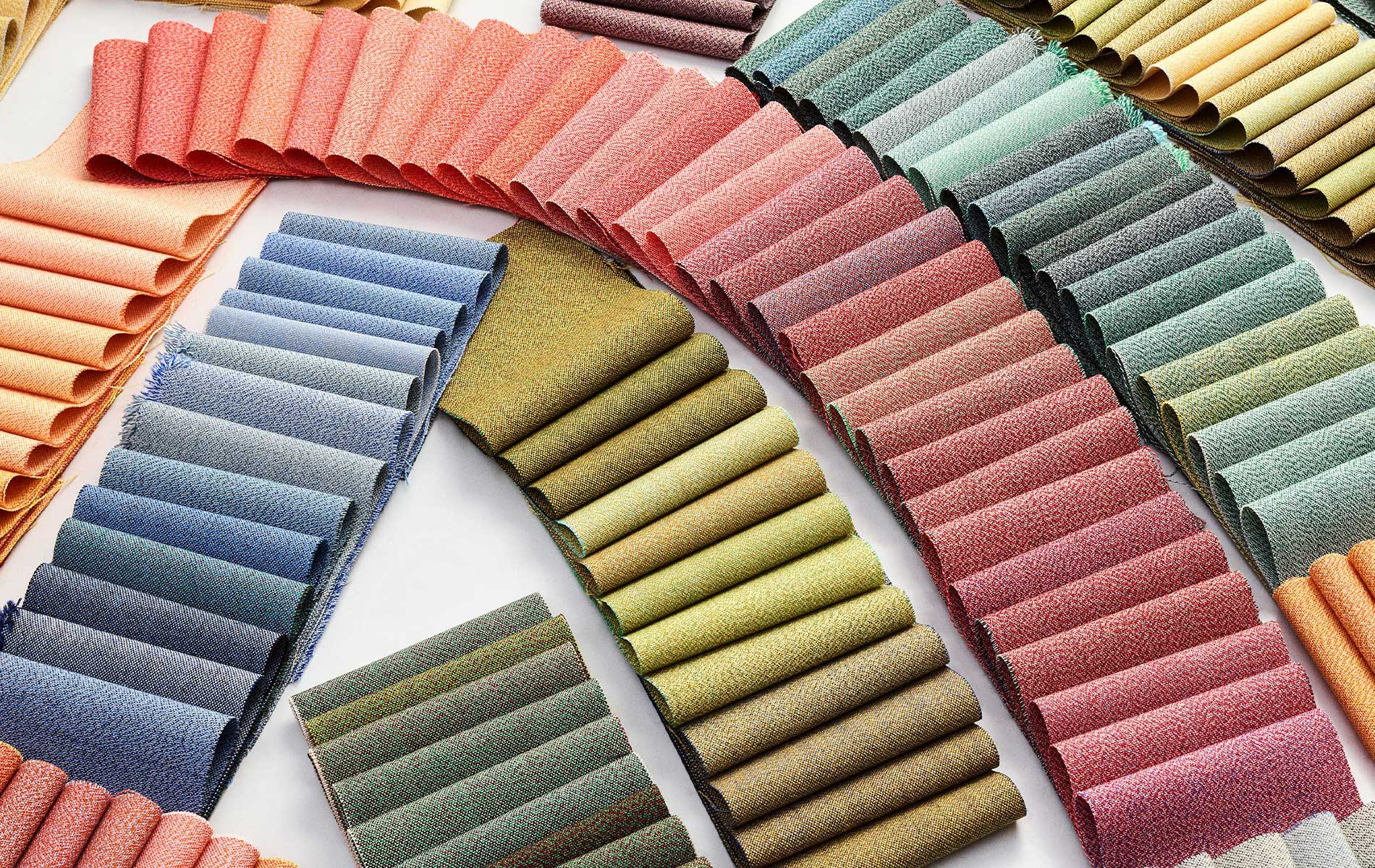
Our upholstery fabrics come from two specialized European weaving mills that have their fabrics comprehensively tested themselves. We can openly show these proofs:
Kvadrat — Re-wool & Vidar collections
- PDFGREENGUARD Certificate
- PDFEU Ecolabel Certificate
- PDFAbrasion Resistance (Martindale)
- PDFLightfastness
Camira — Main Line Flax collection
- PDFFlame Test
- PDFLightfastness
Transparency — even when it’s uncomfortable
Transparency does not mean everything is perfect. Transparency means disclosing and acting.
Example: During a test, permethrin was detected in a wool fleece — an insecticide used as a moth repellent. It did not originate from the production of the material but from storage at the manufacturer: moth repellent was used in the factory, which transferred to the raw material. Our response: The manufacturer changed the storage process.
This is exactly why we conduct these tests — they uncover problems that would never come to light without testing. And we act instead of covering up. That is the difference between a seal on the packaging and a genuine engagement with what is in a product.
Tires — Solight Ecco, Made in Germany
Tires are an often overlooked component. Rubber can contain PAHs (polycyclic aromatic hydrocarbons) — demonstrably carcinogenic. For pneumatic tires, standard products from uncontrolled production are often used.
ANGELCAB relies on Solight Ecco — a high-quality plastic material, Made in Germany:
- Free of harmful substances: Free of phthalates (plasticizers) and PAHs. Completely safe for humans and nature.
- Puncture-proof: No pumping, no flat tire. High resilience — always springs back.
- UV & heat resistant: High temperature and radiation resistance. Ideal for outdoor use.
- Lightweight: Low material density — products are barely noticeable in weight.
- Antibacterial: Natural antibacterial effect. Bacteria and fungi are demonstrably killed.
- 100% recyclable: Modern and environmentally friendly. Can be fully recycled.
Solight Ecco is the opposite of an anonymous supply: a German quality material with known origin and traceable composition.
GREENGUARD Gold
GREENGUARD Gold (UL Solutions) is the strictest emissions certification for sensitive groups, including children. It tests over 10,000 chemicals, limits the emissions of 360+ individual VOCs, and is one of the few certifications that also tests for phthalates. The VOC limit is 220 µg/m³ (standard: 500), the formaldehyde limit is 7.3 ppb (standard: 50).
While our laboratory tests analyze the material composition — what is in the material? — GREENGUARD Gold tests what the finished product emits into the ambient air — what reaches the baby? Two different perspectives, together forming a complete picture.
Source: UL Solutions, GREENGUARD Gold Certification (ul.com).
Source: UL Solutions — GREENGUARD Certification (ul.com)
What this means for your baby
ANGELCAB defines freedom from harmful substances not by what a standard currently permits. But by what BfR, UBA, EPA, and WHO say about the effects of substances on the human body. Each component individually tested, according to the strictest available standards. And if something is found, action is taken — not covered up.
Official Sources at a Glance
References
- BfR — PFAS Statement (bfr.bund.de)
- UBA — GerES-V Study, PFAS in children’s blood (umweltbundesamt.de)
- EPA — Final Toxicity Assessments PFOA/PFOS 2024 (epa.gov)
- WHO — PFAS Chemical Hazards (who.int)
- ECHA — Updated PFAS Restriction Proposal (echa.europa.eu)
- Oeko-Tex — New Regulations 2024 (oeko-tex.com)
- GOTS — Version 8.0, March 2026 (global-standard.org)
- PubMed — Antimony Release from Polyester Textiles 2020
- Environmental Science & Technology — Microplastic Fiber Release
- Ecology Center — Comparative Analysis Virgin vs. Recycled PET
- EU Textiles Ecosystem — “Textile Recycling: Positive Change or Toxic Truth?” 2025
- PubMed — “Xenobiotics in Textiles for Infants” 2025
- PMC — Heavy Metals in Infant Clothing
- Woolmark — Wool is Fire Resistant (woolmark.com)
- IWTO — Wool and Flame Resistance (iwto.org)
- UL Solutions — GREENGUARD Gold Certification (ul.com)
- CPSC — Flame Retardants Guidance (cpsc.gov)
- Frontiers in Materials — Phosphorus Flame Retardants Review 2025
- Solight Ecco — Material Properties (solight-ecco.de)
- Bremer Umweltinstitut — Analysis Reports 2017 & 2021